
We are Utopia
Thomas More’s Utopia, and the birth of a genre

We are living through an odd moment in history. Some in the environmental literary community are openly calling for a new wave of utopianism. “Demand Utopia Now”, as some might put it.
Today we are going to look at the origins of utopia. We will do this alongside the origins of the word “utopia”, Thomas More’s Utopia, published in 1516. More importantly we’ll look at the origin of utopian ideas. What do we mean when we say “utopia”?
It turns out those ideas have a history. They start millennia ago, pass briefly through Thomas More gaining the label “utopia”, continuing on to influence everything from Communism to Nazism to modern environmentalism. If you want to “Demand Utopia Now”, then you better figure out what utopia means. Ancient ideas are buried deep within our cultural subconscious, and every time someone sits down to write a utopian manifesto, up those bubbles come. Unless you’re a Nazi or a Stalinist, you might not like some of the origins.
With an awareness of this history, we can choose to imagine futures we actually want, instead of merely repeating old tropes.
Thomas More’s Utopia
A few years after Erasmus published his hit comedy The Praise of Folly, dedicated to his friend Thomas More, he helped Thomas More himself publish his own book – Utopia. If Erasmus laid the egg that hatched into the Reformation, Thomas More also laid a fairly hefty egg which others have been continually hatching ever since.
Utopianism is a long-running, if not universal, human impulse. What Thomas More did was bring one particular strand of utopianism into the modern literary world. Utopia became a genre. That genre has been one of the more politically influential genres in history. When today’s Solarpunks “Demand Utopia Now”, they’re in good company.
Many of the influential works we’ve looked at so far have either been utopias, or included significant utopia elements. Importantly, they all share tropes with Thomas More and his influences. Looking Backward imagines organizing all of life like the military, and having communal kitchens. Star Trek imagines organizing all of life (on the starship anyway) like the military, and everyone eating in a communal kitchen. The utopian high-point of What Is To Be Done? is a communal kitchen. Atlas Shrugged imagines a community hidden in an isolated valley where everyone pursues rationality and virtue, lead by a foundational law-giver. The Dispossessed, by Ursula K Le Guin imagines an isolated community with a foundational law-giver, where everyone lives simple communal lives of non-materialist virtue. These are all part of a single tradition.
Revolutionary movements were commonly motivated by this utopian literature. After the Russian Revolution, Lenin had Thomas More’s name added to the Alexander Garden Obelisk near the Kremlin, putting him alongside Marx and Engels, as well as Chernyshevksy (author of What Is To Be Done?). Was Thomas More a Communist? Not really. But he did lay a very big literary egg.
The full title was De optimo rei publicae statu deque nova insula Utopia, or “Of a republic’s best state and of the new island Utopia.” This is a book in Latin by a Renaissance Humanist written for other Humanists. They liked it. Everyone started writing their own versions. A new genre was born.
We often imagine literary influence as being on a mass public audience. You influence your readers. You change culture by reaching masses of people. Another form of influence is to change other writers. Thomas More created a genre template that people would copy for nearly 500 years. We only recently stopped, because the template is terrible and modern sci-fi/fantasy can do it so much better – The Dispossessed is an example of that transition.
As far as I can tell, no one tried to overthrow the government to create More’s utopia. However, other writers in this genre very much did have that effect. Maoist China and the USSR both created real-world communal kitchens. I’m not sure if that idea is ever in Karl Marx, but it sure is in utopian fiction, and pre-dates Marx by millennia.
The reason why utopianism is politically powerful should be obvious from Thomas More’s full title - “a republic’s best state”. We are talking about constitution writing. At their strongest these are outright manifestos. At their softest they are cultural explorations, ambiguous utopias, an indicator that life could be different.
To believe the world could be different is the very first step to making it so.
The Basic Structure
Utopia is a fairly simple work. The first section is a dialogue. One of the speakers claims to have been to the island of Utopia, somewhere in the recently discovered Americas. In the second section we get a tour of Utopia. It’s a 100% world-building info-dump. This is what sci-fi/fantasy looked like before anyone knew how to write good sci-fi/fantasy. Later editions even included a Utopian con-lang, with alphabet. These are the Renaissance equivalent of Tolkien nerds.
While the structure is hardly worth copying, he is using it to make an argument. Remember, he is a Humanist writing to other Humanists. They want to create a Humanist world modelled on ancient Greece and Rome, combined with Christianity. A lot of these guys work in government, or similar positions. Thomas More himself would later become an advisor to King Henry VIII and Chancellor of England (then get executed for defying the king).
The dialogue acts as a framing device. He presents this as a true conversation that he participated in. We meet the traveller Raphael Hythloday. The name is a pun (because he’s a nerd). The reference is likely evoking the same sense of divine foolishness as in Erasmus’ Folly. We are going to get something foolish which might just be true. We even get a section of dialogue with an actual jester doing exactly this. The other participants in the conversation are all very erudite people.
They begin to debate. It’s starts to sound like Communism.
There are dreadful punishments enacted against thieves, but it were much better to make such good provisions by which every man might be put in a method how to live, and so be preserved from the fatal necessity of stealing and of dying for it.
....
From whence I am persuaded that till property is taken away, there can be no equitable or just distribution of things, nor can the world be happily governed; for as long as that is maintained, the greatest and the far best part of mankind, will be still oppressed with a load of cares and anxieties.
Thomas More is living in the very early days of the enclosure movement, and what would soon become the birth of capitalism. He is bluntly raising the social issues of the day. However, this is long enough ago that he is proto-communist, and proto-liberal, and proto-fascist. What he’s not is happy with the way things are. He raises the possibility of change via cross-cultural comparison. Laws and customs can be different.
Central in all this debate is whether or not it’s worth being an advisor in government. Raphael has seen Utopia. Shouldn’t he do something? Can you actually do any good working in the system? Is it all hopelessly corrupt? Strong arguments are made both for and against trying. Should you, dear reader, get a job in government and try to change the world? We also get a debate on whether or not Utopia is achievable. Surely it wouldn’t work? Ah! But it does!
Having thus set the scene, we then get a full and detailed description of Utopia. Like his friend Erasmus, Thomas More is a fan of satire, so he is being playful with this whole thing. This is much more exploratory than a straight up manifesto. Even so, the core thrust is fairly clear.
The realm of Utopia is a Renaissance Humanist’s fantasy version of ancient Greece. The benefit of writing a fantasy is that he can mix up a bunch of Greek culture and philosophy that never existed together in reality. The real Greece is in need of adaptation. That’s the entire Humanist project. All the readers will have one major reference in mind – Plato. We will get to him. Plato has done this before.
Ancient Greece is the manifesto. We’ve just had a debate about our social problems, and if we should go to work in government implementing the manifesto. Then we get an exploration of fantasy Greece.
It’s not that subtle.
...I love and revere him in the highest degree for what he has written about this isle of the New World, Utopia.
In his history our age and those which succeed it will have a nursery, so to speak, of polite and useful institutions; from which men may borrow customs, and introduce and adapt them each to his own state.
- July 1517, letter from Guillame Budé to Thomas Lupset, published in an edition of Utopia
Why not just write a manifesto? Other people did. Why invent a whole fictional country? It’s the same as for any sci-fi or fantasy writer. You can have so much more fun. There’s jokes, puns, silly names, maps, pictures, the con-lang alphabet. They include introductory letters, where they repeatedly joke that dimwits think utopia is a real place (u-topia? Get it? Ha! Do you even speak Greek?). They’re all nerds. It’s a game. A serious joke. You can also get a kind of nuance and emotive power that just doesn’t come
from
a
list
of
bullet-points.
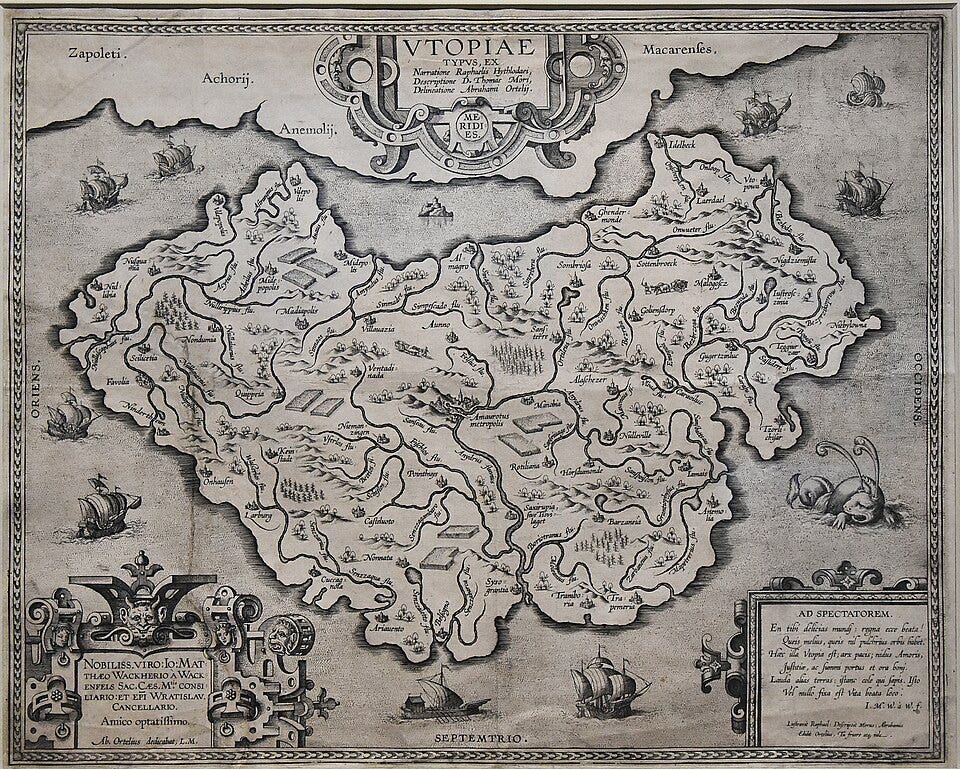
_Abraham_Ortelius_KBS_Brafa_2019.jpg)
Thomas More also gives himself plausible deniability here. Everything is in the mouth of the fictional Raphael, in a fictional No-place. He is mixing in ideas he probably really does want to happen, with many other things that are jokes or curiosities. Thomas More is pursuing a political career. Bluntly saying, “Abolish private property now!” is hardly the word well placed he’s aiming for. Fictional games are far softer and more nuanced than giving a list of demands.
That’s the text.
Thomas More established a template. Many influential people copied him. In the 19th Century people were doing versions of this where people fall asleep and wake up after the revolution. More sets his in a land far far away. Same idea.
Now for the actual content. More has a very particular idea of utopia. European society has been fixated on this version of utopia for millennia. It involves communal kitchens.
A Brief History of Utopianism
Utopianism is a general human impulse. Thomas More mostly just helped bring utopianism into the modern era. Utopianism has long existed in a grey-zone between wish-fulfilment fantasy, religion, cross-cultural curiosity, constitutional law, and a joke. Broadly speaking, we have at least four types of utopia. All of them overlap.
The first is the mythological or religious utopia. The Garden of Eden, Heaven, the Elysian Fields, Valhalla are all utopias. These utopias fill a gap in the believer’s cosmological scheme of the universe. God might take you to Heaven, but you do not create Heaven on Earth.
The second kind of utopia is pure wish-fulfilment. Take every human desire and imagine it being 100% fulfilled. Food. Sex. Love. Diamonds. Immortality. My favourite utopia here is The Land of Cockaigne – the ultimate Medieval peasant fantasy of a world were fish fry themselves for dinner, and celibacy for monks and nuns is decidedly optional. This is pure fantasy, and a bit of joke.
The third kind of utopia really is a joke. These are satires, or criticisms, or straight up dystopias. The Greek comedic playwright Aristophanes had at least two such utopias. In The Birds, the Cloud-cuckoo-landers build a utopian city on a cloud. Hi-jinks ensue. He’s possibly critiquing the colonial fantasy of building a perfect city elsewhere. In The Assembly Women, Athens is taken over by cross-dressing women who convert the city into a “communist” utopia. Private property is abolished, communal kitchens are established, and we achieve perfect equality in free love. Aristophanes pokes fun at how everyone will instantly try to game the system. Given this “communism” is over 2000 years prior to Maoist communal kitchens, we might start to wonder were modern communists got their ideas from. Aristophanes possibly has a very specific example in mind.
The fourth kind of utopia is the manifesto. The softest form is simple cross-cultural comparison. Travel stories, accounts of foreign lands, visitors from Mars. The discovery that other people do things differently quickly turns into the idea that we could do things differently. More’s Utopia is a travel story. Building off cross-cultural comparison we get actual manifestos. You really are supposed to build this thing. Historically, manifesto utopias often share certain features. We abolish private property, establish communal kitchens, and live simple lives of virtue. That’s utopia. They share a common origin, the same as Thomas More.
The modern world is a deeply utopian world. We have multiple utopian strands driving much of what we do. Most of these strands have the same deep roots. You can have a utopia of scientific domination, or of subsistence farming, depending on which strand you emphasize. The modern world did try to establish it’s utopianism as scientific, to break from utopianism’s messy past. However, science itself is also inspired by that same utopianism. We really can’t escape it. As soon as anyone begins their manifesto, up from the nether darkness rises free love, communal kitchens, and isolationist border control.
Let’s see where those ideas come from.
Plato
European culture is overwhelmingly influenced by Plato (or more specifically, neoplatonism). Plato gave us multiple utopias and a dystopia: the Republic, the City of Magnesia in the Laws, and Atlantis. Thomas More’s utopia is self-consciously inspired by these works.
Much like More’s Utopia, the Laws also involves a dialogue with travellers where we compare the social order of foreign lands. We make plans to create a new colony, the utopian City of Magnesia. We get an argument that the aim of law is happiness via virtue, using pleasure and pain to guide human souls. A moderate monarchist-democracy would nice. Self-sufficiency and isolationism is for the best. The simple life breeds virtue. We have a version of equality, communal ownership, and common meals. Okay, sure, it is a strict hierarchy with an underclass of slaves and foreign guest-workers doing all the actual work, but we have equality at the top, where it counts. You do want to put the superior people in charge. They will be the citizens.
Citizenship is military service. Women can serve too. We do have elections, provided you have served in the military. A benevolent dictator always helps in early days of setting up utopia, provided he has a good advisor (like Plato). Above it all, our true ruler will be God himself, in the form of reason, embodied in rational laws. The chief aim of utopia is to elevate the soul towards virtue. The law will come to you as a persuasive ethical instruction – you will be convinced to obey. Violate the religious laws and you will be imprisoned and undergo thought-reform. Literature will be censored. Citizens shall maintain their virtue with gymnastics and choir practice – from birth until death. You will be happy. We shall be happy. We are utopia.

For what it’s worth, I suspect Plato would be horrified by the modern fascism’s rule by cult of personality and think-with-the-gut irrationalism. You really want to moderate the Fuhrer with a senate, and encourage him to study geometry. Anyway...
The Republic is equally utopian. Here Socrates himself lays out the plan. We have three classes. The Philosopher-kings are on top, followed by the virtuous warriors. Up at these top two levels it’s free love, simple living, and communism. We abolish the family, limit private property, and stop caring about gender. Equality! Underneath them are the working class slaves. Together in unity we all seek happiness and virtue. Eugenics shall eliminate the weak. Education and propaganda shall induct you into virtue. The Philosopher-kings will appear to you, lowly slave, as so wise and virtuous that you shall naturally abide by their quasi-totalitarian rule. They shall maintain order so well, that you will thank them. Okay sure, it’s straight up a “noble lie”, but this is what utopia needs. We will be happy. Your books will be censored for telling lies about God. Why aren’t you at choir practice? We are utopia.
In the Timeaus and Critias, Plato gives us something even more fun. He creates the myth of Atlantis, and a war between utopia and dystopia. In the mythic past, Atlantis was a dystopia (by Plato’s standards). Athens was a utopia (see above). However, Atlantis drifted from the divine, and became greedy, unseemly, and debased. The evil Atlantean Empire invaded Europe and Asia, only to be fought back by utopia-Athens. Sadly most of the text of Critias is missing. One can assume Zeus smote Atlantis for failing to attend choir practice. The whole thing feels like a not-so-subtle metaphor to point you to the real world example he has in mind for the Republic. Spoiler: it’s not democratic Athens.
That’s Plato. If you aim to create a utopia of virtue, that’s one way of doing it. Love it or hate, he is trying to solve real world problems. How do you resolve political conflict? How do you get good laws in place? How do you make people happy? Analogous ideas do show up in Confucianism and elsewhere – if only we could create a society with virtuous rulers and virtuous people, that would be good. Plato is the version of this thinking that Europe received. If you remove the elitism and slavery, you are left with things like a mixed constitution with a balance of powers, or indeed free love and communism. In the context of Renaissance absolutist monarchy, mere constitutionalism counts as a radical idea. Every utopia ever since, including Thomas More, are footnotes to Plato. This stuff is very deep in our cultural imagination, because people have been copy-pasting this stuff for over two thousand years.
But who was Plato copying? Ultimately only Plato knows, but there is one plausible option.
Sparta
Forget Ursula K Le Guin’s stupid Omelas utopia, with only one child in a hole. What if we put thousands of children in the hole and made them fight each other with whips?
Sparta!
Like any good utopia, our Spartan utopianism is significantly based on fantasy. They didn’t produce much in the way of enduring art, architecture, or literature. Their lives were, you know... Spartan. Real Sparta was perhaps not so communist or bad-ass as we would like. But that’s far less important than Fantasy Sparta.
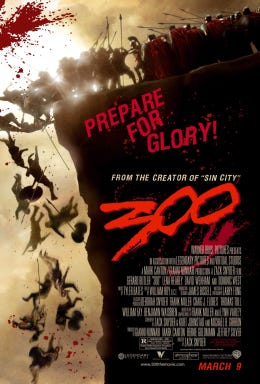

Our Spartan fantasy significantly comes to us from Plutarch’s The Life of Lycurgus. The semi-legendary law-giver of Sparta, Lycurgus, lays out a very particular plan. It has communal kitchens. It’s very similar to Plato’s imaginings. Plutarch is writing after Plato, and even references Plato when describing Sparta. Some of the history is likely factual, some of it not so much.
According to the story, Lycurgus forms his plan by a bit of world travel to do cross-cultural comparison, after which he returns home and revolutionizes Sparta into utopia – the city-state with the best constitution in the world. This is the ultra-hierarchical world fantasized by Plato. The Spartans are a few thousand people ruling over an entire nation of slaves. Just keep that in mind for context.
The Fantasy Spartan constitution follows the middle path between democracy and tyranny – a dual monarchy with a senate and citizen’s assembly. We then have a bunch of things that sound communist. Money and private property are the root of all evil, so they get taken down. We redistribute land. Everyone gets a farm. Lycurgus screws with the currency system so hard that in practice he abolishes money. We then live the simple life. We abolish pointless luxuries. “Rich” and “poor” become meaningless because all are equal, no one has any money, and you can’t buy anything. Being freed from making super-yachts for Jeff Bezos, the Spartan craftsmen can now make really cool cups and tables for the citizens. To cap it off we get communal kitchens.
We also get free love – to allow for eugenics. Deformed infants are killed. The whole system is held together by education. Physical fitness, moderation, and self-control are valued. We are suspicious of art and reading. Induction into hardship, military virtue, and discipline begins in childhood overseen by institutionalized man-boy educational sodomy for the creation of super-soldiers. They also liked a bit of group singing.
I think that’s enough to get the idea.
That is the Fantasy Sparta ideal. No private property will eliminate all the vices caused inequality. No luxuries means we can have universal sufficiency. Strict self-sufficiency and education means we can keep our people virtuous and pure from contamination by the world. The conflict between individual and group interest is solved by subsuming individual life into group life. You probably want a communal kitchen. Mass slavery really helps, but if you’re uncomfortable we can substitute this with either punishing lazy people or with technology.
These ideas keep eternally resurfacing any time someone tries to write a utopian manifesto. Thomas More’s Utopia is a version of this. 20th Century Communism did a lot of this. The Nazi’s liked the xenophobia and eugenics part of this. A lot of technological utopianism comes from a vision of the triumph of virtuous reason (more strong in Plato than Sparta proper). Many environmentalists are living with unconscious dreams of Fantasy Sparta. Hey, what if all moved into an eco-village? We’ll find an isolated rural valley, just like the Spartan homeland. We’ll live the simple life, have a communal kitchen, abolish money,....
Does it work?
Real Sparta only ever done aspects of Fantasy Sparta. At the end of Peloponnesian War, Sparta had a brief moment of glory. Amid the ruins of Athenian democracy, certain Athenian aristocrats looked at Sparta, and thought, “Those guys have the answer!” Shortly thereafter, Sparta collapsed. Thanks to Plato, and guys like Thomas More, Fantasy Sparta would live on eternal. We are Sparta!
Thomas More has plenty more Greek in him, but Plato and Sparta are enough to get us grounded.
The Church
Thomas More was a Christian Humanist. Many of the other utopias following him, as far as the 19th Century, were also explicitly Christian utopias. One fairly blunt example is Christianopolis, from 1619, which combines Platonic Fantasy Sparta on a faraway island with Lutheranism. Plato’s Fantasy Sparta got filtered through Christianity before it got to us. The Fantasy Spartan utopia is significantly based on the overcoming of physical needs as embodied in private property and money. Christianity pushes this to the point of overcoming physical reality and the body itself. The physical world is corrupt. Heaven is utopia.
Christianity has strong tendencies towards utopianism. History is accelerating towards a final climax where all bad things will be destroyed and God will create utopia. Until then it is the role of the believers to join together as equals, forsake material concerns, cut themselves off from contamination by the world, eat communal meals, and strive for virtue (sound familiar?). Church is a pre-figurative utopia.
Now all who believed were together, and had all things in common, and sold their possessions and goods, and divided them among all, as anyone had need.
So continuing daily with one accord in the temple, and breaking bread from house to house, they ate their food with gladness and simplicity of heart, praising God and having favor with all the people.
- Acts 2:44-46
Christianity itself was strongly influenced by Plato, though I’m unsure how much they directly took from The Republic. Either way, utopia-Church is aligned closely enough. The free-love and militarism tends to get replaced with chastity and purity, but the core remains. European culture has had huge amounts of Spartan and Christian utopianism baked in for a very long time. Ask someone to imagine utopia, and there’s a good chance that Christian virtues like Hope, Love, and Faith will start bubbling up in their minds (maybe we could have a new utopian genre and call it Hope-something? Hope-Sparta? Church-punk? No? Terrible idea?). In our minds, utopia is highly likely to look like religiously bonded communities of virtue.
Science and Progress
Once you have the idea of utopia, it’s only a small jump to get to the idea of progress. We can make a better society. We can make a society that keeps getting better forever. Once you have the idea that utopia is run by rational Philosopher-Kings, it’s only a small jump to see that the best path to utopia is science. Put these two together and you get modern technological optimism. Society will keep getting better and better through science.
Francis Bacon was a foundational figure in the history of modern science. A century after Thomas More, he wrote a Utopia-clone, the New Atlantis (he even references Utopia). In the story, sailors discover Christian Platonic Fantasy Sparta somewhere on an island in the New World. Instead of Lycurgus, they have King Solamona (get it? King Solomon). The most important utopian thing the wise king does is found a research institute. Science is utopia.
Fast forward another century, and during the French Revolution we have the Marquis de Condorcet seeing all of history as a battle of science over superstition aimed towards utopian progress. The world we now live has always been a utopian project.
Do you want utopia now? We already have so much.
Contemporary Environmental Utopianism
The modern world is a utopian project. Can you fix utopia with more utopia? Maybe.
In the context of the last ten years, “Demand Utopia Now!” is a radical statement. We are very much stuck. Demanding visions of alternatives serve an obvious purpose.
Over the longer run however, is utopia radical? Maybe not so much. Neoliberalism was utopian. The entire modern world is utopian. European culture has had deep levels of utopianism for a very long time. So the question becomes, does our current call for utopianism escape this past, or simply repeat it? Are we just seeing yet another round of Scientific Christian Platonic Fantasy Sparta?
Yes and no. There’s definitely elements creeping in.
We are all inheritors of the past. Modern utopias also have their fair share of isolated communities, simple-living, abolishing money, abolishing private property, communal kitchens, scientific progress (to compensate for the absence of mass slavery), free love, and virtue. These are all legitimate answers to hard questions. Plato and the Spartans were dealing with real problems, just like we are. But if you ever find yourself drawn to this stuff, you do have to ask: Do I actually believe that’s the answer, or am I just repeating old tropes?
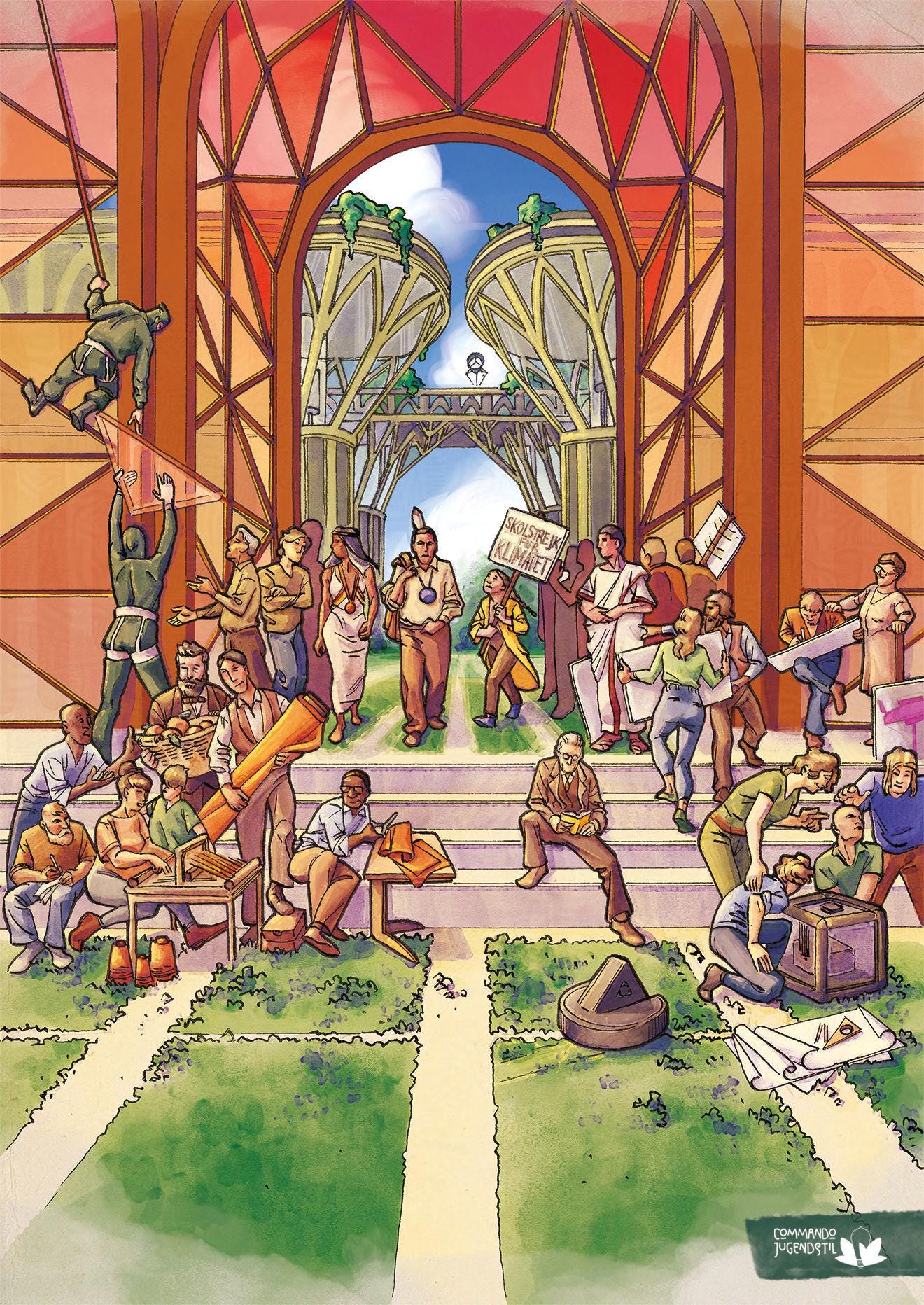
Whatever answers you reach, the questions have been there a long time.
Therefore I must say that, as I hope for mercy, I can have no other notion of all the other governments that I see or know [besides Utopia], than that they are a conspiracy of the rich, who, on pretense of managing the public, only pursue their private ends, and devise all the ways and arts they can find out; first, that they may, without danger, preserve all that they have so ill-acquired, and then, that they may engage the poor to toil and labor for them at as low rates as possible, and oppress them as much as they please; and if they can but prevail to get these contrivances established by the show of public authority, which is considered as the representative of the whole people, then they are accounted laws.
- Thomas More, Utopia, 1516
And that will do us for influential fiction for a while. I have inklings of a new series, picking up where the climate series ended. We’ll see how that goes.